End-to-end Discovery
From an ambiguous brief to a structured, costed proposal. For a telecom client that meant three solution directions across two rendering technologies, each pre-validated with engineering before it reached the table.
 Weronika Malcher
Please open it on a larger screen.
Senior Product Designer · Framing problems, shaping direction, shipping products
About
Senior Product Designer. I design B2B products that don't try to impress at first glance, but earn trust the longer you use them.
I trained as an industrial designer, and what pulled me towards UX was never the finished object. It was the part before it: research, user feedback, and how something actually gets used. Since 2019 I've designed SaaS, enterprise and marketplace products across fintech, IoT, telecom, supply chain and HR tech, most recently leading discovery end to end at Synergy Codes.
I'm most useful when the question is still open. Through discovery and workshops I help teams decide what to build and why, then I design it through to release: the model, the information architecture, the screens, and the work with engineers until it ships.
Senior Product Designer with 7+ years in B2B products, and a path that started with physical objects.
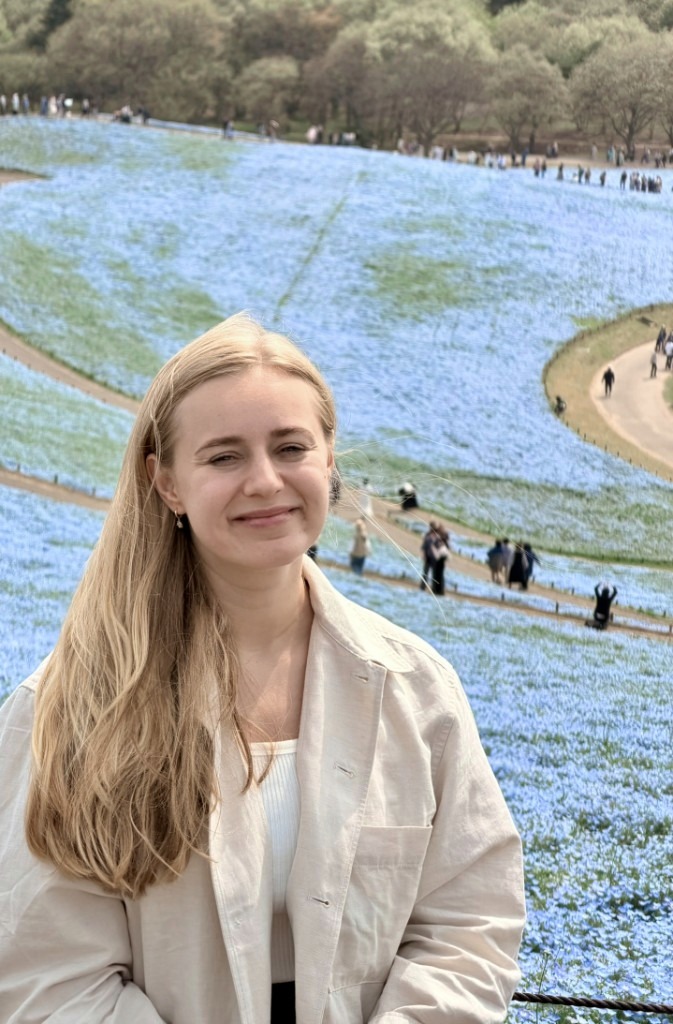
Outside work I travel, mostly towards nature. I've seen a good part of Asia, from Japan and South Korea to Vietnam and Indonesia, and driven through the US national parks, from Yosemite and Zion to Death Valley and the Grand Canyon. I've also spent three multi-month workations abroad, the longest five months, so remote work is something I've tested in practice, not just a preference. The photo is from Hitachi Seaside Park in Japan.
Software house. Led discovery end to end and designed products with hard technical and regulatory constraints.
Software house. Discovery, workshops and product design for clients in fintech, telecom, IoT and supply chain.
Freelance, alongside Brainhub. Owned the design end to end: interface, brand identity and data visualisation, through to launch.
Part of a two-person design team at OmegoFleet; product work in fintech at SAGA Capital.
Calm products are a strategy, not a style.
I like products that give people room: a clear order, nothing competing for attention without a reason, everything where you'd expect it. That calm rarely comes from the visual layer. It comes from earlier decisions about what the product won't do, and those decisions start long before the first screen.
I collect more than the brief asks for: business goals, real workflows, engineering limits, regulation. Then I cut it down to one direction the team can test.
Two users asking for the same feature rarely need the same thing. I look for the difference before designing the answer.
Information architecture and design systems that keep the tenth feature as coherent as the first.
I use Claude, Gemini and NotebookLM every day for research, synthesis and decision support, and Cursor to prototype and build in code. AI shortens the path to a first version, so more of my time goes where it matters: deciding what to build and what to leave out.
A confusing label costs as much as a confusing flow. I write interface copy in plain language and treat it as part of the design, not a final pass.
I take a product from the first sketch to something a team can build: the information architecture, the model, and the screens. Low and mid fidelity while the decisions are still open. The final interface once the structure is settled.
I want to know who it is for, and why it should exist, before a screen is worth drawing. I choose the method for the question in front of us, and I run it so the team gets a useful answer in the time they have.
I design and run the workshop, and the team leaves with a plan. A startup turns a vision into a scope and a roadmap. A product already shipping gets a clearer position and the next six months. A leadership team sets the goals it will run.
How a product speaks is part of the experience, so I work on positioning, voice and tone where a person meets them: in the interface. That is as far as I go. Identity systems and the wider brand sit outside this work.
Most teams don't need more screens. They need fewer, clearer decisions.
I can run the discovery, facilitate the workshop where the direction gets set, design the product and work with engineering through release, so the problem doesn't get lost between handoffs.
Teams describe me as direct, good at asking the right questions and quick to get to the point. Clients I ran strategy workshops for came back to continue the product work with me.
Rather than chasing passing trends, I help product teams build products that don't shout: a coherent, logical space where people find what they need without thinking about the interface. I shape the information architecture and design systems that keep it that way as the product grows.
My favorite projects start with a brief nobody can fully explain yet.
I take on select product vision and strategy facilitation work, support sales with domain research and estimation, and use AI tools daily as a working part of the design process, not a demo.
Domains
Learning
Tools
About this portfolio: I mapped the structure in Miro, then designed it iteratively in code, with Cursor and Astro. Figma supported the early explorations, but the design decisions were made in the browser, on real content and real screen sizes. What you're looking at is the design.
In practice
From an ambiguous brief to a structured, costed proposal. For a telecom client that meant three solution directions across two rendering technologies, each pre-validated with engineering before it reached the table.
I design the system model first: entities, states, roles, validation rules. Screens follow. In multi-role, regulated products this is where the mess starts, and where it can be fixed.
Vision, strategy and operational workshops that end in decisions and a report the team reuses. Clients came back to continue product work after the session, which is the metric that matters.
Claude, Gemini and NotebookLM for research, synthesis, ideation and decision support. Figma Make and Cursor to turn ideas into working prototypes and code, every day. Proof under pressure: 1st place and Best UX audience award at an internal AI hackathon, delivering the complete UX in one day as the only designer on the team.
PMs, BAs, architects, QA and engineers as daily partners. I join sales calls, advise on domain questions, estimate design work, and research the market, including AI Act regulations.
Accessibility, security and regulatory constraints are part of the design process from day one, not a review checklist at the end. Especially in fintech, telecommunications, and HR tech, where they shape the solution space.
© 2026 Weronika Malcher · Client names withheld under NDA where required